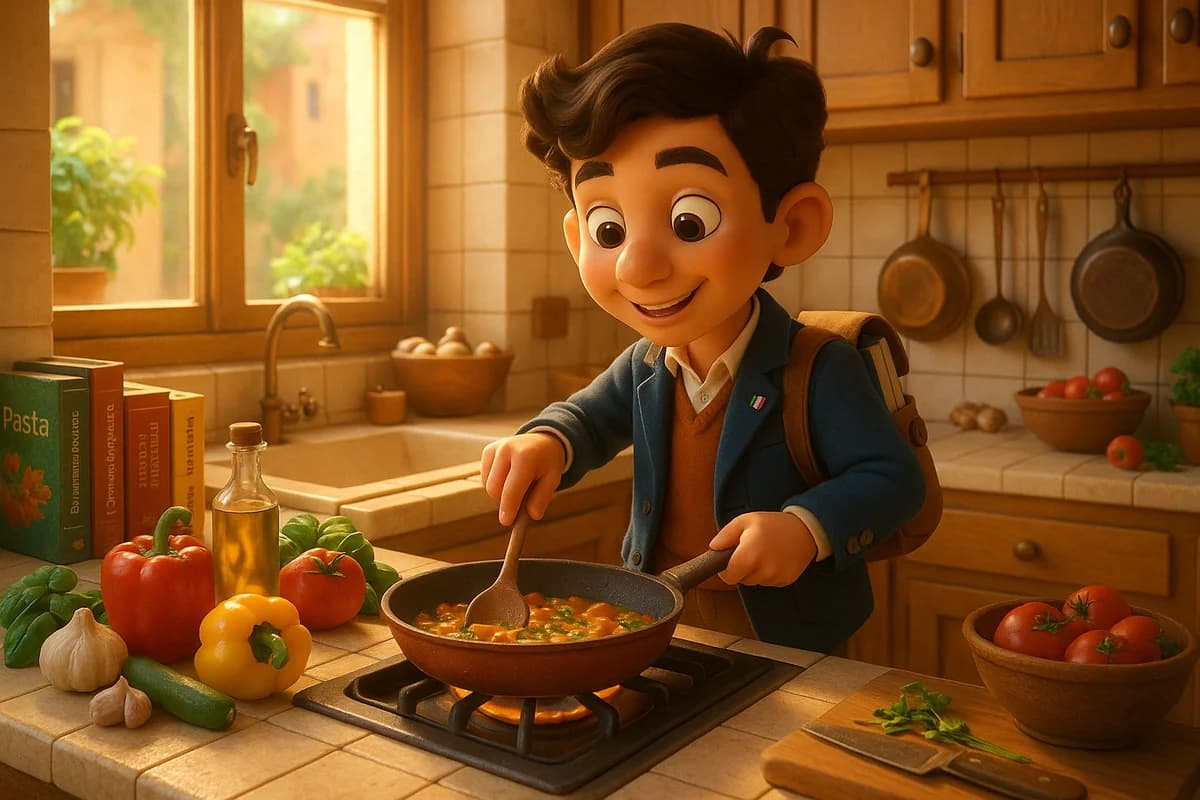

Cooking a recipe in another language is one of the most effective — and most overlooked — vocabulary-building strategies available. Food connects language to sensory memory, cultural context, and genuine need in a way that flashcard drills simply cannot replicate.
The connection between food and language goes deeper than vocabulary lists. Every culture organizes its understanding of the world partly through what it eats: which flavors belong together, which textures are desirable, which ingredients signal occasion versus everyday life. Learning to cook in another language is, quietly, learning to think inside another culture.
Why Food Vocabulary Sticks Better
Memory researchers have documented what language learners have long experienced intuitively: words linked to sensory experience are encoded more deeply than words encountered on a page. When you read a recipe in French — "faire revenir les oignons jusqu'à ce qu'ils soient translucides" — and then actually perform that action, watching the onions turn translucent as the smell fills the kitchen, you have attached the phrase to smell, sight, sound, and physical action simultaneously.
Neuroscientists call this "embodied cognition." Language acquired through physical experience activates more neural pathways than language acquired through reading or listening alone. The word ''amasar'' (to knead, in Spanish) will not leave you if you learned it with your hands in dough.
Starting With Recipes: A Practical Framework
Choose authentic sources, not translated recipes
The difference between reading a French recipe translated into English and reading an actual French recipe is enormous. Translated recipes strip out the cultural syntax — the particular rhythm of instructions, the assumptions about what readers already know, the offhand asides that reveal what the cook considers important. Start with recipes from food blogs in your target language, regional newspapers, or YouTube cooking channels where the host explains as they cook.
Build your culinary vocabulary domain
Before tackling a full recipe, learn the foundational action verbs: slice, dice, simmer, fold, reduce, season, rest. Then the equipment. Then the ingredient categories. Building this domain vocabulary first means recipes become readable quickly — and the vocabulary you acquire is immediately useful in restaurants, markets, and real conversations about food.
Cook the same recipe twice
First time: read the recipe slowly, look up what you don't know, cook. Second time: read without looking anything up, cook from memory. The gap between those two sessions is where acquisition happens. Fluentera's spaced repetition system is built on exactly this principle — the moment just before you forget is when review does the most work.
The Market as a Language Classroom
One of the most transformative experiences for any language learner living in or visiting a country where their target language is spoken is doing the weekly shopping at a local market — not a supermarket, but an outdoor market where you interact with vendors directly.
The market forces productive use of language under low stakes. You need to ask how much something costs, whether the tomatoes are ripe, if there's a smaller portion available. The vendors understand immediately what kind of interaction this is, and most are patient, direct, and pleased when a foreigner makes the effort. Each visit builds on the previous one.
Even before you can travel, you can replicate this by visiting ethnic grocery stores where the staff speaks your target language. The Cantonese-speaking staff at a Hong Kong grocery, the Arabic at a halal butcher, the Portuguese at a Brazilian bakery — these are real conversations around real objects you can hold.
Cultural Immersion Through Cuisine
Food vocabulary opens cultural doors that textbooks cannot. When you understand the difference between ''tapas'' as a concept and ''raciones'' as a format, you understand something about Spanish social culture — that meals are about sharing and lingering, not efficiency. When you know that ''sobremesa'' (the after-meal table conversation) is a named concept in Spanish with no direct English translation, you understand something about what the culture values.
This is what Fluentera means by cultural immersion: not trivia about other countries, but an inside view of how another culture organizes its experience of the world. Food is one of the most accessible entry points because everyone eats, and the vocabulary is immediately, concretely usable.
Korean food culture example
Learning Korean food vocabulary teaches you the structure of a Korean meal (the banchan system of shared small dishes), the concept of eating together as a communal act (the single spoon in the shared pot), and the emotional weight of certain foods (miyeok-guk, seaweed soup, always eaten on birthdays as a mother's gift). None of this is in a grammar textbook. All of it comes from the food vocabulary.
Italian food culture example
Italian has strong opinions about what counts as "proper" food preparation — and the vocabulary encodes those opinions. Learning that "scondito" (unseasoned) is occasionally an insult, or that the specific verb ''insaporire'' (to infuse flavor) describes a technique Italians consider non-optional, tells you something about Italian values around food that influences everything from recipe reading to restaurant ordering.
Ordering Food in Another Language: The Real Test
Ordering food in a restaurant in your target language is one of the most motivating, high-feedback language experiences available. You have a clear communicative goal. The stakes are real but low (the worst outcome is a wrong dish). You get immediate confirmation of success.
A practical framework: before visiting a restaurant, read the menu online in the target language. Look up everything you don't know. Decide what you want. Then, at the table, order without gesturing at the menu. The preparation makes the conversation manageable; the live interaction makes the vocabulary stick.
Frequently Asked Questions
What languages have the richest food vocabulary to learn from?
French, Italian, Japanese, and Chinese are particularly rich because their food cultures are exceptionally developed — each has precise vocabulary for techniques, textures, ingredient preparations, and flavor profiles that don't exist in English. Spanish is excellent for beginners because the food vocabulary is immediately usable across dozens of countries. Thai food vocabulary is unusually sensory and metaphor-rich.
How many food-related words should I target?
A core kitchen and restaurant vocabulary of roughly 200–300 words covers most common situations. This includes action verbs (chop, simmer, season), equipment (pan, colander, ladle), ingredient categories (dairy, legumes, aromatics), and the most common menu terminology. Beyond that, learn what you encounter as you cook rather than front-loading vocabulary you won't use.
Are cooking videos in another language better than written recipes?
Both are valuable, and they train different skills. Written recipes build reading comprehension and expose you to formal culinary vocabulary. Cooking videos (especially casual home cooking channels) expose you to informal speech, regional accents, and colloquial expressions — "just a knob of butter" in a Yorkshire accent versus "une belle noix de beurre" in a French one. Use both.
I don't cook much — can this approach still work for me?
Yes. Even following along with a recipe video without cooking builds vocabulary through visual-auditory pairing. And starting with simple recipes — scrambled eggs, pasta, a salad dressing — requires almost no cooking skill while still delivering rich language exposure. The cooking proficiency required to benefit from this approach is very low.
Language learning that goes beyond vocabulary lists
Fluentera immerses you in authentic cultural contexts — including the food, traditions, and everyday situations that bring language to life. Start your cultural immersion today →