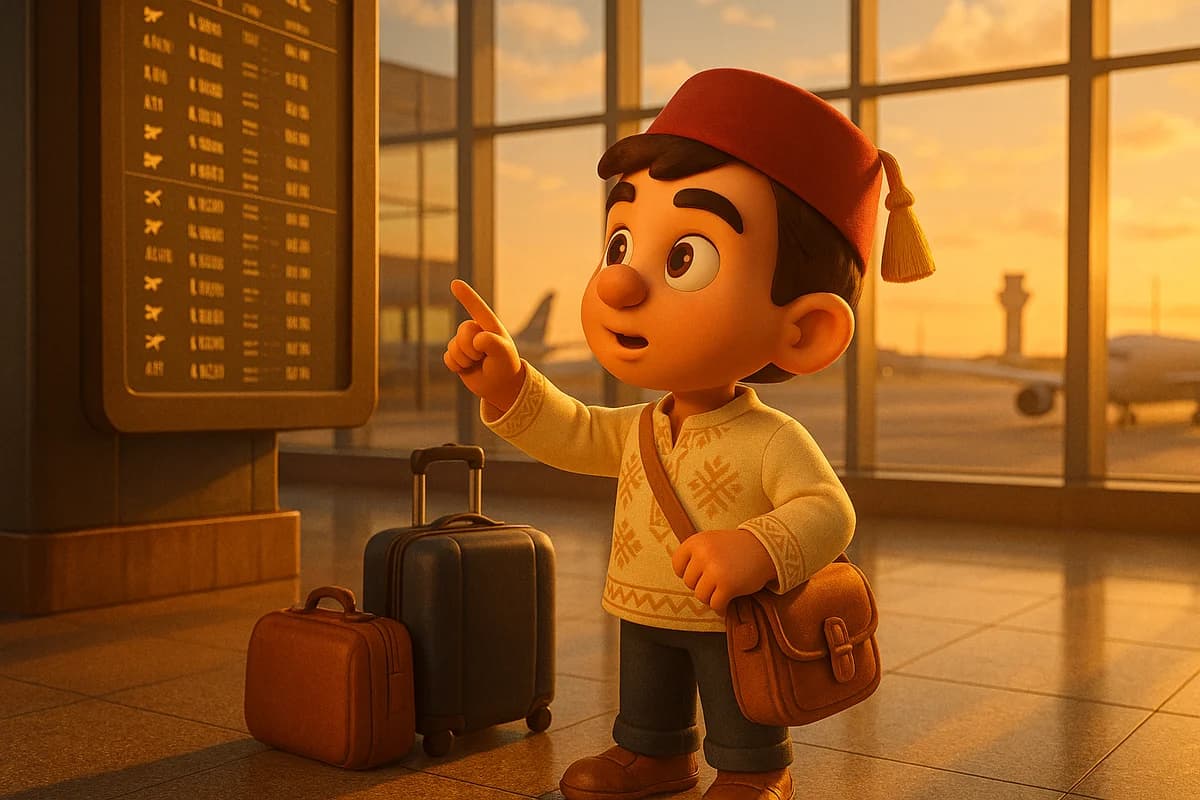

You don't need fluency to transform your travel experience — research from the European Commission's Eurobarometer survey found that travelers who use even 10–15 phrases in the local language report 60% higher satisfaction with their trips. A handful of well-chosen words opens doors that money and pointing simply cannot.
This guide covers the universal categories of travel phrases that work in any language, how to learn them fast before your trip, and the cultural etiquette that turns memorized words into genuine human connection.
1. Greetings and Courtesy: The Phrases That Open Every Door
In every culture, a greeting in the local language signals respect. It tells the person you're speaking with that you see them as more than a transaction. The minimum viable set: hello, good morning/afternoon/evening, please, thank you, excuse me, and goodbye.
Why this matters more than you think: A 2024 study from Cornell University's School of Hotel Administration found that tourists who greeted service staff in the local language received measurably better service — faster response times, more detailed recommendations, and more frequent unsolicited help. The effect was strongest in countries where tourism fatigue is common (Italy, France, Thailand, Japan).
Pro tip: Learn the informal and formal versions of greetings where they exist. In French, "bonjour" works everywhere, but knowing "salut" (casual hi) versus "bonjour, madame/monsieur" (formal) shows cultural awareness. In Japanese, "konnichiwa" is safe for daytime, but "sumimasen" (excuse me) is the true magic word — it opens conversations, gets attention politely, and functions as both "sorry" and "thank you" depending on context.
2. Directions and Navigation: Getting Where You Need to Go
GPS handles most navigation, but there are situations where asking a human is faster, more reliable, or the only option — rural areas, underground metro systems, markets, and neighborhoods where street addresses are impractical. Essential phrases: Where is...?, left, right, straight ahead, near, far, how far?, stop here (for taxis).
The sentence pattern to memorize: "Where is [place]?" This single construction — "Dove il...?" in Italian, "...wa doko desu ka?" in Japanese, "Donde esta...?" in Spanish — combined with the name of your destination handles 80% of navigation needs. Pair it with numbers (for understanding "three blocks," "five minutes") and you're functionally independent.
Body language backup: When the response comes in a flood of words you don't understand, watch their hands. Pointing, gesturing left or right, and holding up fingers for distance are universal. Nod, say thank you, walk in the indicated direction, and ask again when in doubt. Locals generally find this endearing, not annoying.
3. Food and Dining: Ordering With Confidence
Food is the fastest path to cultural connection, and restaurant interactions follow predictable scripts. Learn: I would like..., the menu please, the bill/check please, water, this one (while pointing), delicious!, do you have...?, I am allergic to..., no [ingredient] please, and thank you for the meal.
Allergy and dietary phrases are non-negotiable. If you have food allergies, learn the specific phrase in the local language before you arrive and carry it written on a card. "I am allergic to peanuts" needs to be unambiguous and correctly phrased — this is not the place for charades. Many travel health organizations offer free allergy translation cards in 50+ languages.
Beyond survival, food vocabulary is the most rewarding to learn. Complimenting a chef in their language, asking what a dish is called, or saying "this is delicious" (oishii in Japanese, muy rico in Spanish, tre bon in French) creates moments of genuine connection. A study published in the International Journal of Hospitality Management found that tourists who ordered food in the local language were 45% more likely to receive off-menu recommendations from restaurant staff.
Fluentera builds travel-ready vocabulary into every story adventure — you learn phrases for ordering food, asking directions, and navigating real-world situations because the story demands it, not because you're drilling a flashcard deck.
4. Shopping and Money: Handling Transactions
Markets, shops, and street vendors operate on a basic transactional vocabulary that's remarkably consistent across cultures. Essential phrases: How much?, too expensive, discount?, I'll take it, do you accept credit cards?, where is the market/shop?, small/medium/large, and numbers (at minimum 1–100).
Numbers are the highest-ROI vocabulary for travelers. They appear in prices, addresses, bus numbers, hotel rooms, phone numbers, times, and quantities. Learn them first. Most languages have patterns that make counting to 100 manageable once you know 1–10 and the tens (20, 30, 40...).
In bargaining cultures (much of Southeast Asia, the Middle East, parts of Latin America and Africa), knowing numbers in the local language shifts the dynamic entirely. A vendor who quotes "200" in English is pricing you as a tourist. When you respond "yee sip" (twenty in Thai) or "khamseen" (fifty in Arabic), the negotiation becomes person-to-person, not tourist-to-vendor. You won't always get a lower price, but you'll always get more respect and a better experience.
5. Emergencies and Safety: The Phrases You Hope to Never Use
Emergency phrases should be learned cold — no fumbling, no app-checking. Memorize these before arrival: Help!, I need a doctor, call the police, hospital, I am lost, fire, and a phrase to communicate your specific medical conditions.
Also critical: your embassy's local phone number, stored in your phone and written on a card. "I need my embassy" in the local language can be a lifeline. Keep a photograph of your passport on your phone and know the phrase "I lost my passport."
Beyond true emergencies, know phrases for everyday safety situations: "leave me alone," "I don't want it," and a firm "no, thank you" for persistent hawkers. In many cultures, a polite refusal in the local language is more effective than any amount of English repetition. Cultural context matters here — in some countries, making eye contact while refusing is important; in others, simply walking away without engagement is the norm.
6. Transportation: Buses, Trains, Taxis, and Rideshares
Transportation vocabulary is universal across travel destinations. Key phrases: one ticket to..., round trip, what time does it leave/arrive?, which platform/gate?, stop here please, how long does it take?, is this the right bus/train for...?, and the next stop.
For taxis specifically, always know how to say your destination clearly, ask "how much to [destination]?" before getting in (where meters aren't standard), and "use the meter, please" where they are. In many countries, writing your destination in the local script on your phone and showing it to the driver is more effective than attempting pronunciation. Google Translate's camera feature can help you read signs, and its conversation mode handles basic back-and-forth in real time.
A practical hack: Screenshot your hotel's name and address in the local script on your phone. When you need to get back and can't pronounce the address, simply show the screen to a taxi driver. This works in every country and removes the most stressful "lost tourist" scenario entirely.
7. Learning Travel Phrases Quickly: A Pre-Trip Strategy
You don't need months of study to arrive prepared. With 2–4 weeks of focused practice (15–20 minutes per day), you can internalize 50–80 essential phrases — enough to handle greetings, food, directions, shopping, and basic emergencies in any language.
Week 1: Greetings, please, thank you, excuse me, yes, no, numbers 1–10. Week 2: Food ordering phrases, "where is...?", directions (left/right/straight), numbers to 100. Week 3: Shopping phrases, transportation vocabulary, emergency words. Week 4: Review and practice all phrases in simulated scenarios — order food from an imaginary waiter, ask for directions to landmarks, negotiate a price.
Pronunciation matters more than grammar for travel. A grammatically imperfect phrase with clear pronunciation communicates. A grammatically perfect phrase with incomprehensible pronunciation does not. Listen to native speakers saying each phrase (YouTube, language apps, or Fluentera's audio-rich stories) and mimic their rhythm and intonation, not just the individual sounds.
Technology as backup, not replacement: Google Translate, DeepL, and dedicated travel phrase apps are excellent safety nets. But pulling out your phone creates a barrier between you and the person you're speaking with. The person who stumbles through "une table pour deux, s'il vous plait" with a smile will always have a warmer experience than the one who silently holds up a phone screen.
Frequently Asked Questions
How many phrases do I really need for a trip?
Between 30 and 50 phrases cover 90% of tourist interactions. Focus on greetings (5–6 phrases), food (8–10), directions (6–8), shopping (5–6), transportation (5–6), and emergencies (5–6). Quality and pronunciation matter more than quantity — 30 well-pronounced phrases outperform 100 poorly remembered ones.
What if I pronounce things wrong and embarrass myself?
You almost certainly will mispronounce things — and it almost certainly won't matter. In the vast majority of cultures, attempting the local language is seen as deeply respectful. Locals will help you, gently correct you, and appreciate the effort. The only embarrassing choice is not trying at all.
Are translation apps good enough to skip learning phrases?
Translation apps are impressive backup tools, but they fail in several common travel scenarios: no internet access, noisy environments where speech recognition struggles, rapid market negotiations, and any interaction where warmth and human connection matter. Learning basic phrases and using apps as backup is the optimal strategy.
Should I learn the local script or just pronunciation?
For short trips (under 2 weeks) to countries with non-Latin scripts (Arabic, Thai, Japanese, Korean, etc.), focus on pronunciation and carry a cheat sheet of essential words in the local script. For longer stays or deeper immersion, learning to read basic signs and menus is worth the investment — it typically takes 1–3 weeks depending on the script.
What's the single most useful phrase in any language?
"Thank you." It's used dozens of times daily, it's universally appreciated, and it's typically easy to pronounce. If you learn only one word before your trip, make it the local word for "thank you" — and say it often, with a genuine smile.
Traveling soon?
Fluentera builds travel-ready vocabulary into immersive story adventures — learn essential phrases for 20+ languages by living them in context, not memorizing lists. Start your first adventure free