
Arabic is spoken by over 420 million people across 26 countries, making it the fifth most spoken language in the world. It's also one of the six official languages of the United Nations. Yet for English speakers, it consistently ranks among the most challenging languages to learn — the U.S. Foreign Service Institute estimates 2,200 class hours to reach professional proficiency, placing it in Category IV alongside Mandarin and Japanese.
The good news: Arabic's difficulty is front-loaded. Once you crack the script, grasp the root system, and build foundational vocabulary, the language reveals a beautiful internal logic that makes progress feel increasingly rewarding. This guide walks you through everything a beginner needs to know to start learning Arabic effectively.
1. Master the Arabic Script First
Arabic is written from right to left using a 28-letter alphabet. Every letter has up to four forms depending on its position in a word — initial, medial, final, or isolated. This sounds intimidating, but the variations are mostly subtle shape changes, and many letters share the same base form differentiated only by dots.
The critical first step: Dedicate your first 2–3 weeks exclusively to the Arabic alphabet. Most learners can recognize and write all 28 letters within 10–14 days with daily practice. Start with the isolated forms, then learn how letters connect. Arabic is a cursive script — letters within a word are almost always joined, flowing from right to left.
A few practical tips: practice writing by hand, not just on screens. The physical act of forming letters from right to left builds muscle memory faster. Focus on the six letters that don't connect to the following letter (ا، د، ذ، ر، ز، و) — these break the word into visual segments and help you read more quickly. And learn the short vowel marks (fatha, kasra, damma) alongside the consonants. Beginner texts include these marks; advanced texts do not, so building the habit early is essential.
2. Understand MSA vs. Dialects
One of the most important decisions for an Arabic learner is which form of Arabic to study. Modern Standard Arabic (MSA or fusha) is the formal, standardized version used in news broadcasts, literature, academic writing, and official settings across all Arabic-speaking countries. No one speaks MSA as their native daily language.
Regional dialects — Egyptian, Levantine, Gulf, Maghrebi, and others — are what people actually speak in everyday life. These dialects can differ significantly from MSA and from each other. An Egyptian speaker and a Moroccan speaker might struggle to understand one another's dialect, though both understand MSA.
The recommended approach for most beginners: Start with MSA to build your grammatical foundation and reading ability, then layer a specific dialect based on your goals. If you want to travel to or communicate with people from a specific region, begin adding that dialect early. Egyptian Arabic is the most widely understood dialect due to Egypt's dominant media industry. Levantine Arabic (spoken in Syria, Jordan, Lebanon, Palestine) is another popular choice.
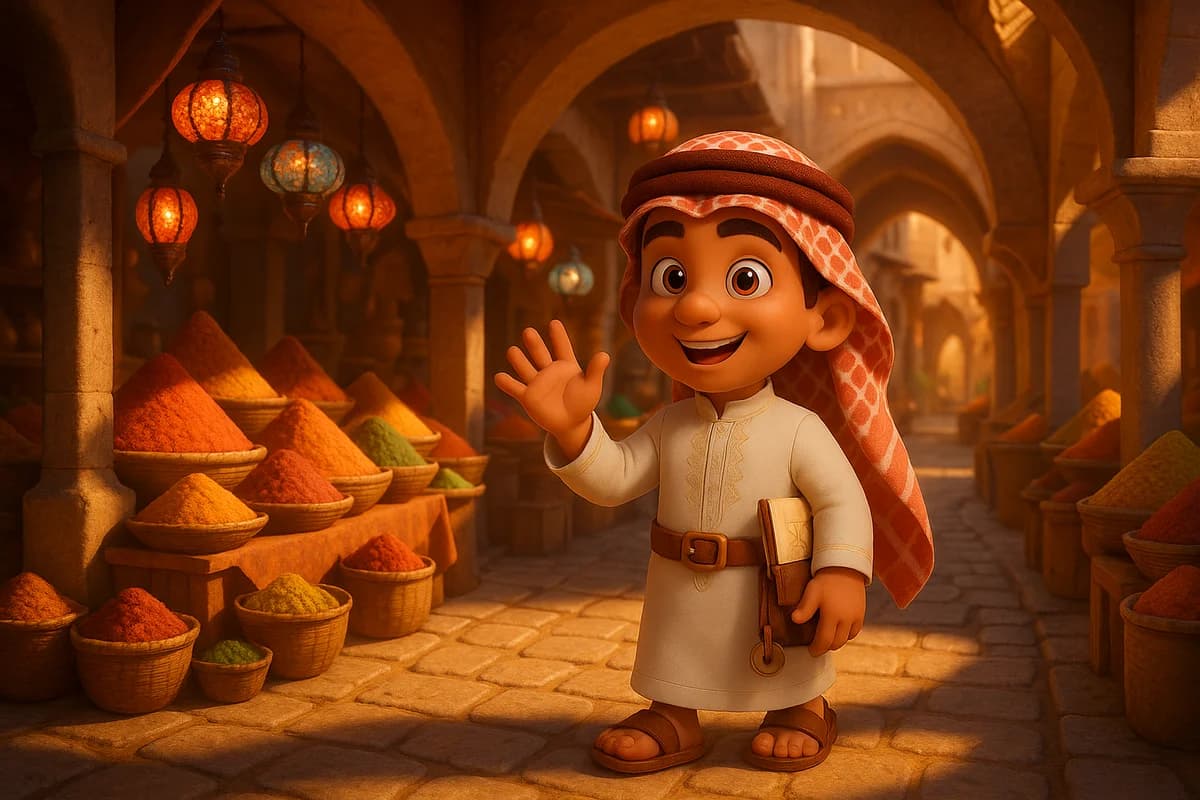
Fluentera teaches Arabic through immersive story adventures set in real Arab-world locations — from Cairo's bustling souks to the ancient streets of Marrakech — helping you absorb both formal patterns and natural conversational usage in context.
3. Leverage the Root System
Arabic's root system is the single most powerful feature for vocabulary acquisition. Most Arabic words are built from three-consonant roots that carry a core meaning. By learning a root, you unlock an entire family of related words.
For example, the root ك-ت-ب (k-t-b) relates to writing. From it you get: كتاب (kitab — book), كاتب (katib — writer), مكتبة (maktaba — library/bookstore), مكتوب (maktub — written/letter), and كتابة (kitaba — writing/the act of writing). One root, five immediately useful words.
The root د-ر-س (d-r-s) relates to studying: درس (dars — lesson), مدرسة (madrasa — school), مدرس (mudarris — teacher), دراسة (dirasa — study/studies). Research published in the Journal of Arabic Linguistics found that learners who actively studied root patterns acquired new vocabulary 40% faster than those who memorized words individually.
Practical strategy: When you learn a new word, identify its three-letter root and look up related words. Keep a root journal. Within a few months, you'll start recognizing roots in unfamiliar words and intuitively guessing their meanings — a breakthrough moment for every Arabic learner.
4. Build Essential Vocabulary
The most common 1,500 Arabic words cover approximately 80% of everyday conversation. Prioritize these categories in your first six months: greetings and courtesy phrases (مرحبا/marhaba — hello, شكرا/shukran — thank you, من فضلك/min fadlak — please), numbers 1–100, common verbs (يذهب/yadhhab — to go, يأكل/ya'kul — to eat, يريد/yurid — to want), question words, family terms, food vocabulary, and direction/location words.
Use spaced repetition to lock in vocabulary. A 2023 meta-analysis in the Annual Review of Applied Linguistics confirmed that spaced repetition systems produce 35–50% better long-term retention compared to massed study across all languages, with Arabic showing particularly strong gains due to the script reinforcement benefit.
Learn vocabulary in phrases, not isolation. "أريد قهوة" (urid qahwa — I want coffee) is more useful and more memorable than learning "أريد" and "قهوة" separately. Context gives words meaning, and meaning gives words staying power in your memory.
5. Navigate Pronunciation Challenges
Arabic has several sounds that don't exist in English, and mastering them early prevents fossilized pronunciation errors. The most challenging sounds for English speakers include:
ع (ayn): A deep, voiced pharyngeal fricative produced by constricting the throat. There is no English equivalent. Start by saying "ah" while tightening the back of your throat — it should sound strained and deep. This sound distinguishes dozens of minimal pairs, so it's not optional.
ح (ha): A voiceless pharyngeal fricative — like a breathy, whispered "h" from deep in the throat, distinct from the regular English "h." خ (kha): Similar to the Scottish "ch" in "loch" or the German "ch" in "Bach." غ (ghayn): A gargling sound produced at the back of the throat, close to the French "r" in "Paris." ق (qaf): A deeper version of "k" produced further back in the throat.
Practice tip: Record yourself pronouncing these sounds and compare with native speakers. Focus on one difficult sound per week rather than trying to perfect all of them simultaneously. Arabic speakers will understand you even with imperfect pronunciation — but getting these sounds right dramatically improves comprehension and earns immediate respect from native speakers.
6. Practical Study Tips for Consistent Progress
Study daily, even briefly. Twenty minutes of Arabic every day produces better results than two hours once a week. The script and vocabulary require frequent reinforcement, especially in the first six months.
Consume Arabic media early. Arabic-language music, news (Al Jazeera offers slower-paced programs for learners), TV shows, and podcasts provide essential listening input. Egyptian dramas and comedies are particularly accessible due to slower dialogue and cultural popularity.
Label your environment. Stick Arabic labels on objects around your home. Seeing كتاب on your bookshelf and باب on your door creates passive daily reinforcement of both vocabulary and script recognition.
Find a language partner. Arabic speakers are overwhelmingly generous with learners. Even basic efforts to speak Arabic — a greeting, a simple question — are met with genuine warmth and encouragement. Use language exchange platforms to practice speaking from month two onward. Don't wait until you feel "ready" — you'll never feel ready, and early speaking accelerates all other skills.
Set CEFR-aligned milestones. Aim for A1 (basic greetings, simple phrases) by month 3, A2 (simple conversations on familiar topics) by month 8–10, and B1 (handling most travel and social situations) by month 18–24. These timelines assume 30–45 minutes of daily study. Fluentera's story-based approach keeps you engaged through narrative momentum — you keep studying because you want to know what happens next, not because a streak counter is guilting you.
Frequently Asked Questions
Is Arabic harder than Mandarin or Japanese?
The FSI rates all three as Category IV languages requiring 2,200+ hours. The difficulty is different, not necessarily greater. Arabic's script is alphabetic (28 letters vs. thousands of characters), which makes reading accessible faster. The root system accelerates vocabulary growth. However, the dialect situation adds complexity that Mandarin and Japanese don't have.
Should I learn to read Arabic or speak it first?
Learn the script and basic speaking simultaneously. The alphabet takes 2–3 weeks and unlocks all written resources. Meanwhile, learn spoken greetings and common phrases from day one. The two skills reinforce each other — reading solidifies vocabulary that speaking makes natural.
Which Arabic dialect should I learn?
If you have a specific country connection (travel, family, work), learn that dialect. If not, Egyptian Arabic is the most widely understood across the Arab world thanks to Egypt's film, music, and media dominance. Levantine Arabic is another strong choice, especially for those interested in Syria, Jordan, or Lebanon.
Can I learn Arabic without a tutor?
Yes, many successful learners are self-taught using a combination of apps, textbooks, media immersion, and language exchange partners. A tutor accelerates pronunciation and provides conversational practice, but isn't strictly necessary. The key is daily consistency and diverse input sources.
How long until I can have a basic conversation in Arabic?
With consistent daily study (30–45 minutes), most learners can handle basic greetings, introductions, and simple transactions within 2–3 months. Holding a sustained conversation on familiar topics typically takes 8–12 months. Dialect speakers will appreciate your efforts long before you reach conversational fluency.
Ready to start your Arabic journey?
Fluentera teaches Arabic through immersive story adventures set in real locations across the Arab world — from Cairo's historic bazaars to the ancient medinas of Morocco. Begin your first adventure free