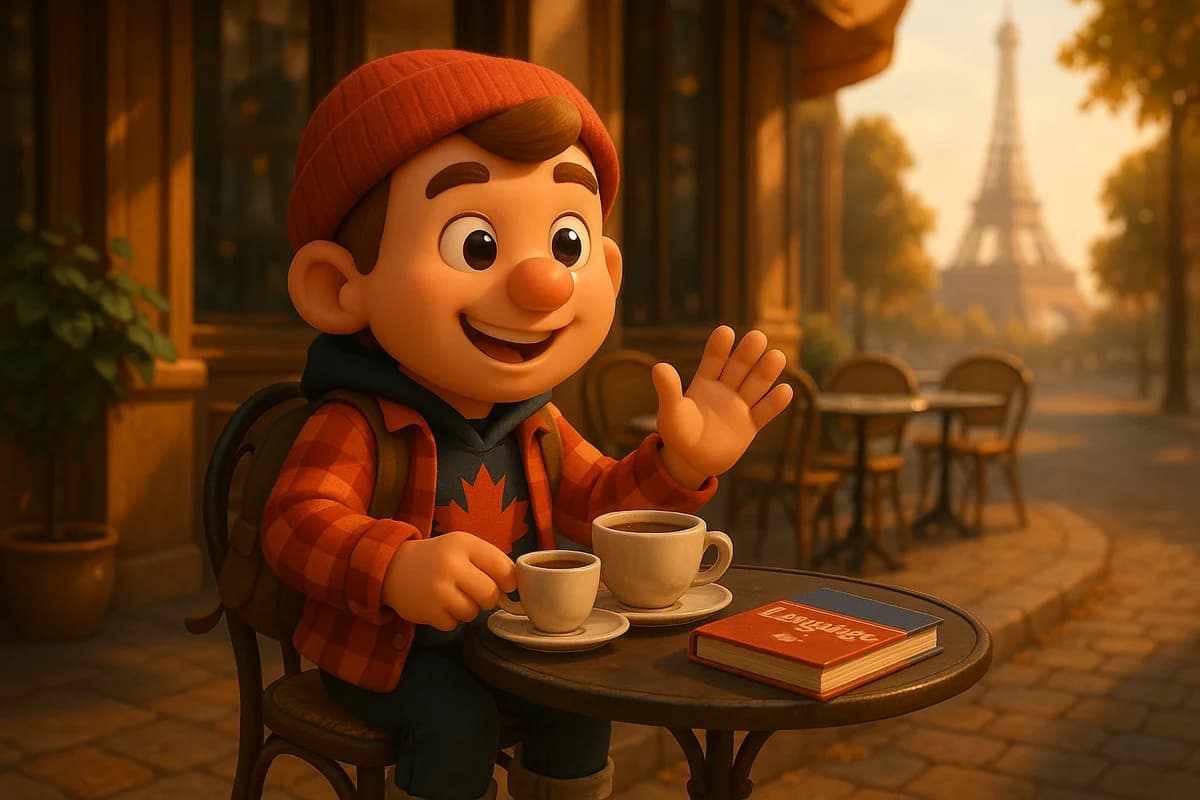

French is one of the most accessible languages for English speakers — the Foreign Service Institute estimates roughly 600–750 class hours to reach professional working proficiency, placing it in the easiest category alongside Spanish, Portuguese, and Italian. With over 321 million speakers worldwide and official status in 29 countries, French opens doors across Europe, Africa, Canada, and the Caribbean.
This guide covers everything you need to know to start learning French effectively, from pronunciation fundamentals to grammar essentials and study strategies that actually work.
1. French Pronunciation: Easier Than You Think
French pronunciation has a reputation for being difficult, but it follows surprisingly consistent rules once you learn them. Unlike English, where spelling and pronunciation are often unpredictable, French spelling-to-sound rules are remarkably regular — you just need to learn the system.
Key sounds to master early: The French "r" (a soft, uvular sound produced at the back of the throat), nasal vowels (an, en, on, un — where air passes through the nose instead of the mouth), and the "u" sound (as in "tu" — round your lips as if saying "oo" but try to say "ee"). These three sound categories account for most of the pronunciation challenges English speakers face.
Silent letters are predictable. In French, final consonants are usually silent unless followed by an "e" — so "petit" sounds like "puh-TEE" but "petite" sounds like "puh-TEET." The consonants C, R, F, and L (remember the word "CaReFuL") are typically pronounced at the end of words. Once you internalize these patterns, reading French aloud becomes far more natural.
Liaison — the linking of a normally silent final consonant to the vowel beginning the next word — is another distinctly French feature. "Les amis" (the friends) is pronounced "lay-zah-MEE," not "lay ah-MEE." This creates the flowing, musical quality that makes French so distinctive.
2. Essential Grammar Concepts for Beginners
French grammar shares more DNA with English than most learners realize — roughly 45% of English words have French origins thanks to the Norman Conquest of 1066. But there are key structural differences to understand from day one.
Gendered nouns: Every French noun is either masculine (le) or feminine (la). There's no reliable logic for most genders — "le livre" (book) is masculine while "la table" (table) is feminine. The best strategy is to always learn the article with the noun. Don't memorize "maison" (house) — memorize "la maison." Over time, you'll develop an intuition for gender patterns (words ending in -tion are almost always feminine, words ending in -ment are usually masculine).
Verb conjugation: French verbs change form based on who is performing the action. The good news is that regular verbs follow predictable patterns grouped into three conjugation families: -er verbs (parler — to speak), -ir verbs (finir — to finish), and -re verbs (vendre — to sell). The -er group contains approximately 90% of all French verbs, so mastering that pattern alone covers most situations.
Start with these essential verbs: Être (to be), avoir (to have), aller (to go), faire (to do/make), pouvoir (to be able to), and vouloir (to want). These six irregular verbs appear in nearly every French conversation. Learn their present tense conjugations first, then expand to passé composé (past tense) and futur proche (near future — "aller + infinitive").
3. Building Your First 500 Words
French vocabulary is surprisingly friendly for English speakers. Research from Concordia University suggests that English and French share approximately 1,700 true cognates — words that look similar and mean the same thing in both languages. Words like "important," "possible," "difficult," "national," and "information" are identical or nearly identical in both languages.
Prioritize these vocabulary categories: Greetings and polite expressions (bonjour, merci, s'il vous plaît), numbers 1–100, common adjectives (grand, petit, bon, mauvais, nouveau), food and restaurant vocabulary, directions and transportation, and time expressions (aujourd'hui, demain, hier).
The most effective approach is learning words in context rather than from isolated lists. When you encounter "boulangerie" (bakery) in a story about visiting a French neighborhood, the word sticks because it's connected to a scene, an image, and an emotional context. Fluentera builds on this principle — vocabulary appears naturally inside animated story adventures set in real French locations, so you remember words because you needed them to follow the narrative.
4. How Story-Based Learning Accelerates French
A 2023 meta-analysis published in the Modern Language Journal found that narrative-based instruction produced 28% better vocabulary retention and 35% higher comprehension scores compared to traditional drill-based methods. The reason is neurological: stories activate multiple brain regions simultaneously — visual processing, emotional response, sequential memory — creating richer, more durable neural connections.
For French specifically, stories provide natural exposure to grammar in context. Instead of memorizing the rule that adjectives typically follow nouns in French ("une voiture rouge" — a red car), you encounter dozens of examples in natural sentences and internalize the pattern automatically. This mirrors how native French children learn — through massive exposure to correctly structured language, not grammar drills.
Fluentera applies this research directly: each lesson is an episode in an ongoing animated adventure. You follow characters through French markets, cafés, and neighborhoods, picking up vocabulary and grammar because the story demands it. The emotional investment in the narrative creates what linguists call "incidental learning" — you acquire language without the conscious effort that makes traditional study feel draining.
5. Practical Study Tips That Work
Consistency beats intensity. Studying French for 20 minutes every day produces dramatically better results than a 3-hour weekend marathon. Language learning relies on spaced repetition — your brain needs regular, distributed encounters with new material to transfer it from short-term to long-term memory.
Use French media from day one. Start with French music (lyrics are excellent for pronunciation), then progress to podcasts designed for learners (like "Coffee Break French" or "InnerFrench"). As your level improves, add French films with French subtitles — not English subtitles, which your brain will default to reading instead of listening.
Label your environment. Put sticky notes on objects around your home with their French names — "la porte" on your door, "le réfrigérateur" on your fridge, "la fenêtre" on your window. This creates passive daily exposure that reinforces vocabulary without additional study time.
Think in French as soon as possible. During your daily routine, narrate simple actions in French: "Je me brosse les dents" (I brush my teeth), "Je prends mon café" (I have my coffee). This builds the mental habit of producing French, not just recognizing it.
Don't fear mistakes. French speakers — despite stereotypes — are generally encouraging toward learners who make genuine effort. A 2024 survey by Alliance Française found that 82% of French respondents said they appreciated foreigners attempting to speak French, even imperfectly.
6. Common Mistakes Beginners Should Avoid
Translating word-for-word from English. French sentence structure differs in important ways. Adjectives typically follow nouns ("un chat noir" not "un noir chat"), object pronouns precede the verb ("je le vois" — I see him, literally "I him see"), and negation wraps around the verb ("je ne parle pas" — I don't speak).
Ignoring gender from the start. It's tempting to learn nouns without articles and "add gender later." This creates bad habits that are extremely difficult to correct. Always learn "le/la" as part of the word itself.
Skipping listening practice. French is notoriously different in its spoken and written forms. The phrase "je ne sais pas" (I don't know) is typically pronounced "shay-pah" in casual speech — dropping entire syllables. Without consistent listening exposure, you'll be able to read French but unable to understand spoken conversation.
Waiting until you're "ready" to speak. You will never feel ready. Start speaking in the first month, even if it's just simple phrases at a French restaurant or basic exchanges with a language partner. Early speaking practice, however imperfect, builds confidence and reveals gaps that reading alone won't expose.
7. Recommended Learning Resources
For structured learning: "Assimil — French With Ease" is widely considered the gold standard for self-study textbooks. Its dialogue-based approach introduces grammar naturally through conversations. For a more traditional approach, "Grammaire Progressive du Français" (published by CLE International) is what most French language schools use worldwide.
For listening: RFI (Radio France Internationale) offers "Journal en français facile" — a daily news broadcast in simplified French. TV5Monde provides free French content with multilevel subtitles. For podcasts, "InnerFrench" by Hugo Cotton is excellent for intermediate learners.
For speaking: iTalki connects you with native French tutors at affordable rates. Tandem and HelloTalk offer free language exchange partnerships. Even 15 minutes of weekly conversation practice accelerates progress dramatically.
For immersive, story-based learning: Fluentera combines animated narratives with structured language instruction — ideal for learners who want to make progress without the monotony of traditional textbook exercises.
Frequently Asked Questions
How long does it take to learn French?
The FSI estimates 600–750 hours for English speakers to reach professional working proficiency (B2/C1 level). With consistent daily study of 30–45 minutes, most learners reach conversational comfort (B1 level) within 8–12 months. Basic tourist-level French (A1–A2) is achievable in 2–3 months.
Is French harder than Spanish for English speakers?
They're in the same FSI difficulty category, but each presents different challenges. French pronunciation is harder initially due to nasal vowels and silent letters, while Spanish pronunciation is more straightforward. French has slightly more verb irregularities, but its vocabulary overlap with English is larger. Most learners find them comparably difficult overall.
Do I need to learn French grammar rules explicitly?
A combination works best. Explicit grammar study helps you understand patterns, while immersive exposure (reading, listening, stories) helps you internalize them. Learners who rely solely on grammar rules speak slowly and mechanically; those who skip grammar entirely make persistent structural errors. Aim for both understanding and intuition.
Which French accent should I learn — Parisian, Québécois, or African French?
Standard metropolitan French (based on Parisian speech) is the most widely taught and understood globally. It's the safest starting point. Once you have a solid foundation, exposure to other accents comes naturally. Québécois and African French varieties are fully valid — but learning materials and tutors are more readily available for metropolitan French.
Can I learn French by watching French movies?
Movies are an excellent supplement but not sufficient alone. At the beginner level, French films move too fast for meaningful comprehension. Start with learner-oriented content, then graduate to films with French subtitles at the A2/B1 level. Use the pause-and-repeat technique: pause after each subtitle, repeat what you heard, check your understanding, and continue.
Ready to start your French journey?
Fluentera teaches French through immersive story adventures set in real locations across France — from Parisian cafés to Provençal markets. Begin your first adventure free →