
Italian is widely considered the most approachable Romance language for English speakers — its pronunciation is nearly perfectly phonetic, its grammar follows consistent patterns, and roughly 30% of English vocabulary shares Latin roots with Italian cognates. The Foreign Service Institute classifies Italian as a Category I language, estimating just 600–750 hours to reach professional proficiency.
This guide covers everything a beginner needs to start learning Italian effectively: pronunciation fundamentals, essential grammar, vocabulary strategies, cultural immersion, and practical study tips that will carry you from your first "ciao" to confident conversation.
1. Italian Pronunciation: Your Biggest Advantage
Italian is the most phonetically consistent of the major Romance languages. Unlike French (with its silent letters) or Portuguese (with its nasal vowels), Italian is almost entirely "what you see is what you say." Once you learn a handful of pronunciation rules, you can read any Italian word aloud correctly — even words you have never seen before.
The five vowels are pure and consistent: A (as in "father"), E (as in "bed" or "day"), I (as in "machine"), O (as in "more" or "go"), U (as in "rule"). Unlike English, these vowel sounds never change based on surrounding letters. "A" always sounds the same, whether it appears in "casa" (house), "amare" (to love), or "banana" (yes, it's the same word).
Key consonant rules to master early: "C" before E or I sounds like "ch" in "church" (cena = "chena"). "C" before A, O, or U sounds like "k" (casa = "kasa"). "G" before E or I sounds like "j" in "jelly" (gelato = "jelato"). "G" before A, O, or U is hard, like "g" in "go" (gatto = "gatto"). Double consonants are pronounced longer and with more emphasis — "nono" (ninth) and "nonno" (grandfather) are different words.
Spend your first week drilling these rules. Record yourself reading Italian words and compare with native audio. This small investment pays enormous dividends — correct pronunciation from day one means you will not need to unlearn bad habits later.
2. Essential Grammar: Articles, Verbs, and Sentence Structure
Italian grammar is more structured than English but follows predictable rules. The three areas beginners should prioritize are articles, present-tense verb conjugations, and basic sentence structure.
Articles: Italian has definite articles (il, lo, la, i, gli, le — equivalent to "the") and indefinite articles (un, uno, una, un' — equivalent to "a/an"). Which article you use depends on the gender (masculine/feminine) and number (singular/plural) of the noun, plus the first letter of the following word. This sounds complex, but patterns emerge quickly: most nouns ending in -o are masculine (il libro — the book), and most ending in -a are feminine (la casa — the house).
Verb conjugations: Italian verbs fall into three groups based on their infinitive ending: -are (parlare — to speak), -ere (scrivere — to write), and -ire (dormire — to sleep). Each group follows a consistent conjugation pattern. For -are verbs in the present tense: io parlo (I speak), tu parli (you speak), lui/lei parla (he/she speaks), noi parliamo (we speak), voi parlate (you all speak), loro parlano (they speak). Learn the -are pattern first — it covers the majority of common Italian verbs.
Sentence structure: Italian follows Subject-Verb-Object order, just like English. "Marco mangia la pizza" (Marco eats the pizza) maps directly onto English word order. The main difference is that adjectives usually follow the noun (una macchina rossa — a car red — a red car) and the subject pronoun is often dropped because the verb conjugation already indicates who is acting (parlo = I speak, without needing "io").
3. Cognates: Your Built-In Vocabulary
English and Italian share thousands of cognates — words that look and sound similar because they derive from the same Latin roots. This gives English speakers a massive head start in building Italian vocabulary.
Direct cognates: Words that are nearly identical include musica (music), problema (problem), informazione (information), famiglia (family), importante (important), possibile (possible), naturale (natural), and hundreds more. You can often guess the meaning of Italian words in context simply by recognizing their English relatives.
Pattern-based cognates: Many English-Italian cognate pairs follow predictable transformation rules. English words ending in "-tion" often become "-zione" in Italian (nation/nazione, education/educazione). Words ending in "-ty" become "-tà" (university/università, city/città). Words ending in "-ble" become "-bile" (possible/possibile, terrible/terribile). Learning these patterns instantly gives you access to hundreds of Italian words.
Watch for false friends: Some Italian words look like English words but mean something different. "Camera" means "room" (not a photographic device), "magazzino" means "warehouse" (not a magazine), and "attualmente" means "currently" (not "actually"). There are only a few dozen common false friends, and learning them early prevents confusion.
4. Regional Dialects and Standard Italian
Italy has extraordinary linguistic diversity. Before unification in 1861, the peninsula was a patchwork of kingdoms and city-states, each with its own dialect — many of which were mutually unintelligible. Neapolitan, Sicilian, Venetian, Milanese, and Sardinian are not just accents but distinct linguistic varieties with their own grammar and vocabulary.
The good news for learners: standard Italian (italiano standard), based on the Florentine Tuscan dialect, is spoken and understood everywhere. It is the language of education, media, government, and formal communication throughout Italy. When you learn "Italian," you are learning this standard form, and it will serve you in every region.
That said, awareness of regional variation enriches your experience. You will hear different accents, local expressions, and dialectal words depending on where you are. Romans might say "daje" (come on!), Neapolitans use "uè" as a greeting, and Milanese might slip in "pirla" (a local term for a silly person). These regional flavors are part of what makes Italian culture so rich — embrace them as you encounter them, but focus your study on standard Italian.
5. Learning Through Italian Culture
Italian culture provides an extraordinary ecosystem for language learning. Food, art, cinema, music, and sports offer endless entry points for meaningful engagement with the language — and research consistently shows that emotionally engaging content is retained far more effectively than dry textbook material.
Food: Italian cuisine vocabulary is a gateway to the language. You already know dozens of Italian food words: pizza, pasta, espresso, cappuccino, risotto, bruschetta, prosciutto. Expand from there — learn the names of dishes on a real Italian menu, follow Italian cooking channels on YouTube (Giallo Zafferano is Italy's most popular cooking site), or read Italian recipes. Food vocabulary connects to daily life, making it highly retainable.
Cinema: Italian cinema is one of the richest in the world. Start with accessible modern films like "La Grande Bellezza" (The Great Beauty) or "Perfetti Sconosciuti" (Perfect Strangers), which use contemporary conversational Italian. Watch first with English subtitles for comprehension, then again with Italian subtitles to connect spoken and written forms. Classic directors like Fellini and Rossellini offer cultural education alongside language exposure.
Music: Italian pop and folk music provide excellent listening practice. Artists like Måneskin, Lucio Dalla, and Laura Pausini offer varied listening material. Song lyrics are particularly useful because they combine repetition, rhyme, and emotional content — three factors that enhance memorization.
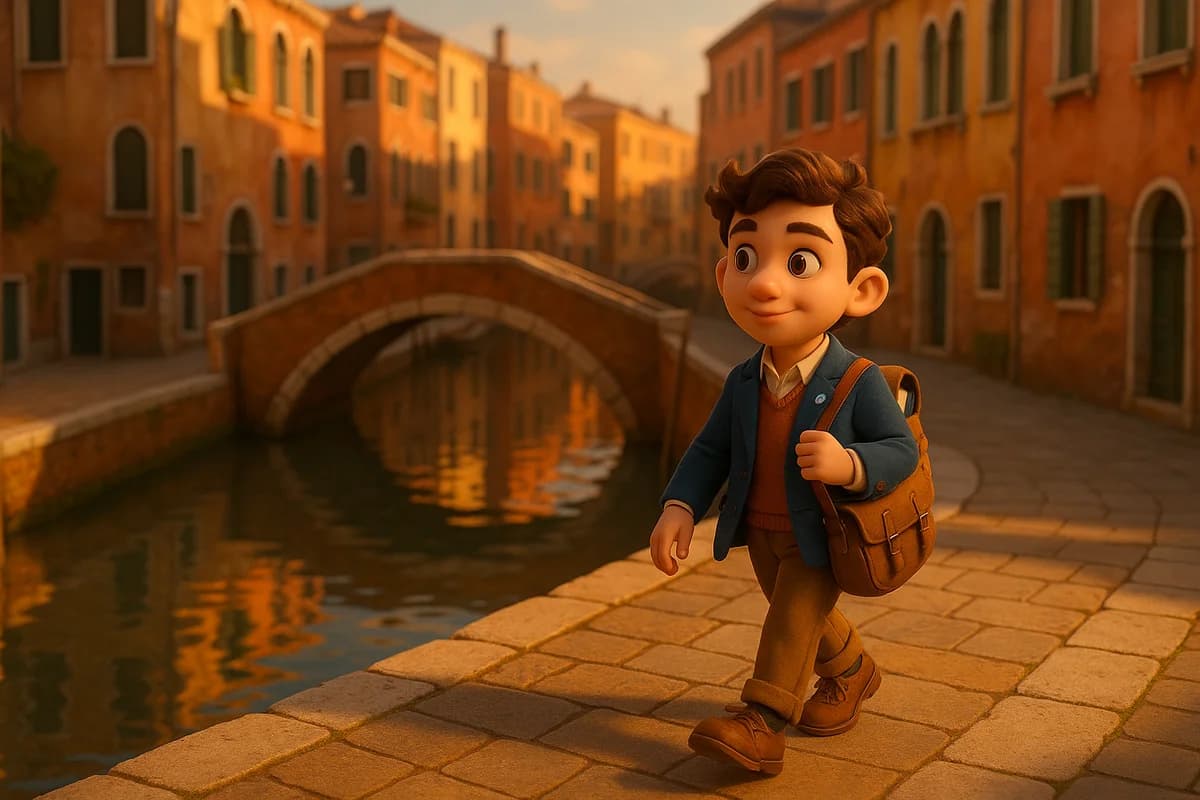
Fluentera takes this cultural immersion approach to its logical conclusion — teaching Italian through animated story adventures set in real Italian locations, from the canals of Venice to the hills of Tuscany, so vocabulary and grammar are always embedded in culturally rich, meaningful contexts.
6. Study Tips for Italian Beginners
Start speaking from week one. Italian pronunciation is forgiving, and native speakers are famously warm toward foreigners who try to speak their language. Even basic phrases like "Buongiorno, come sta?" (Good morning, how are you?) and "Vorrei un caffè, per favore" (I'd like a coffee, please) build speaking confidence. The earlier you start producing the language, the faster it will become natural.
Use spaced repetition for vocabulary. The forgetting curve is steep — without review, you lose approximately 70% of new vocabulary within 24 hours. Spaced repetition systems (SRS) like Anki or the built-in review features in Fluentera combat this by surfacing words at optimal intervals. Even 10 minutes of daily vocabulary review dramatically improves retention.
Focus on high-frequency words first. The 1,000 most common Italian words cover approximately 85% of everyday speech, according to frequency data from the Corpus di Italiano Contemporaneo. Prioritize these: essere (to be), avere (to have), fare (to do/make), dire (to say), andare (to go), volere (to want), potere (to be able), dovere (to must), sapere (to know), and venire (to come). These ten verbs alone appear in a huge percentage of Italian sentences.
Set a realistic daily habit. Consistency matters more than duration. Twenty minutes every day produces better results than two hours once a week. Tie your Italian practice to an existing habit — study during your morning coffee, listen to an Italian podcast during your commute, or review vocabulary before bed. The habit anchor makes it easier to maintain the routine.
Don't fear mistakes with gender. Getting noun gender wrong is the most common mistake for English speakers learning Italian, and it is also the most harmless. Italians will understand you perfectly even if you say "il problema" correctly but mix up "il/la" on less common nouns. Accuracy with gender improves naturally with exposure — do not let it become a source of anxiety that prevents you from speaking.
Frequently Asked Questions
How long does it take to learn Italian?
The FSI estimates 600–750 class hours to reach professional working proficiency (B2/C1 level). For a self-studier practicing 30 minutes daily, that translates to roughly 3–4 years to reach advanced levels. However, basic conversational ability (A2/B1) is achievable within 6–12 months of consistent study. Italian's phonetic consistency and cognate overlap with English make early progress faster than with most other languages.
Is Italian useful outside of Italy?
Italian is spoken by approximately 85 million people worldwide. Beyond Italy, it is an official language in Switzerland, San Marino, and Vatican City, and has significant speaker communities in the United States, Argentina, Brazil, Canada, and Australia. It is also one of the 24 official languages of the European Union. Italian is particularly valuable in industries like fashion, food, art, design, automotive engineering, and classical music.
Should I learn Italian or Spanish first?
If your motivation is primarily practical (most speakers, broadest geographic reach), Spanish has the advantage with 500+ million speakers across 20+ countries. If your motivation includes culture, cuisine, travel to Italy, or personal heritage, choose Italian. The two languages share approximately 80% lexical similarity, so learning one makes the other significantly easier afterward. Choose the one that excites you more — motivation is the strongest predictor of success.
What are the best resources for learning Italian?
Combine multiple approaches: a structured course or app for grammar foundations, a spaced repetition tool for vocabulary, Italian media (films, podcasts, music) for listening practice, and conversation exchange for speaking. No single resource covers all skills. The best resource is the one you will actually use consistently every day.
Is Italian grammar hard?
Italian grammar is more inflected than English (verbs conjugate, nouns have gender, adjectives agree) but less irregular than French or Spanish. The subjunctive mood and pronoun system are the most challenging aspects for English speakers, but these come at intermediate and advanced levels. Beginner grammar is highly regular and pattern-based, making early progress smooth.
Ready to start your Italian adventure?
Fluentera teaches Italian through immersive story adventures set in real Italian locations — from Venice's canals to Rome's ancient streets. Begin your first adventure free today.